Changes to your favorite Michigan woodland can occur before noticeable changes appear from stand or field edges. They can occur in the form of storm damage, logging, invasive plants, flooding, and in some cases even human activity that affects cover that deer use. However, keeping records of changes to your property also can create disturbance. The best approach to monitoring changes to your favorite hunting spots is to monitor in a modest fashion and keep a record of what you find before the changes become more obvious.
Start with a baseline before the woods look different
Create a simple map or write down your observations of the property in a notebook. Identify the major types of cover on your property, the location of fields and openings, sources of water, fallen trees, trails and roads through your property, areas of bedding, and all of the locations where deer cross through your property. This type of information can be recorded on a simple map, and then reviewed at a later time to see if any changes have occurred.
Record the following items before heading out to monitor your property: recent logging, high water, windfall, mowed game trails, new fencing, nearby construction, and an increase in traffic on nearby roads. Also make note of the weather and ground conditions on the days you visit your property. This will help you to understand why a particular area may seem to be unused by deer on a given day. Missing deer tracks can be due to the ground being frozen, leaves being dry, and/or the time of year.
Use photographs to record changes to your Michigan woodland. Take pictures from the same locations at about the same time of year. Be sure to include the entire scene within the frame of your photograph. In this way, you can take photographs of the same screening edge at different times of the year. You can also use photographs to record whether a deer crossing has become muddy, or whether a fallen tree has blocked a route through the woods.
Read the symptoms before changing your setup
A wooded area can be changing slowly over time before noticeable decline. Browse lines on smaller vegetation can increase in height as it is continually consumed by deer. Screening edges can be thinned by wind fall that is not cleaned up. Drainage areas can change over time resulting in standing water in areas that previously did not hold water. Tranquil trails that deer regularly use can disappear as vegetation grows in and blocks the path.
Remember that absence of signs of deer using a trail can be caused by many things including very cold weather and very dry leaves. Also, remember that decreased sign of use does not necessarily mean that deer have abandoned a trail. Instead, the deer may be using the trail at a different time.
Multiple signs indicating a decline in deer numbers including reduced cover, soil disturbances (in various forms), blocked water features, and declining use of an area over time, indicate that there is likely more going on with your habitat than can be addressed with additional cameras and longer sits. A closer examination of your habitat is warranted.
Use trail cameras as quiet reference points
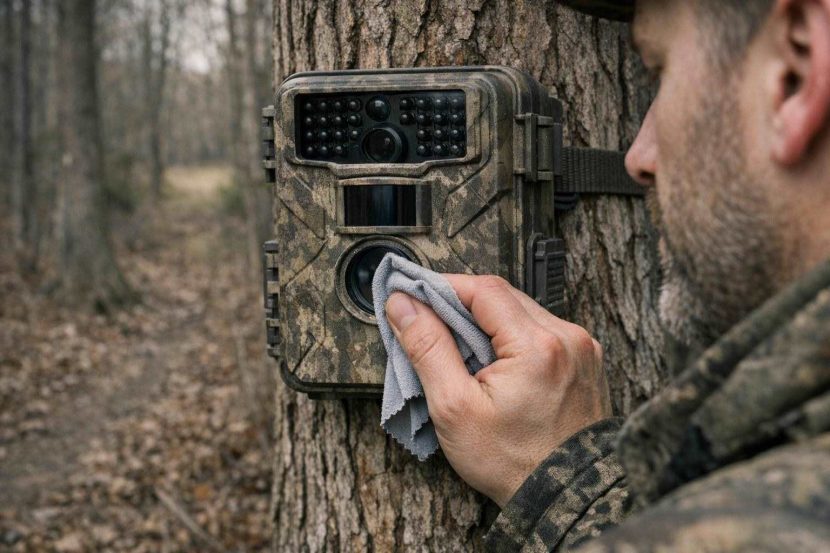
Trail cameras should be used on the same locations and for the same purposes that you would normally go to scout. This can reveal so much more than you can see in one visit, but remember to check the cameras at the same times and under the same circumstances as you normally would scout. Set up the cameras to take pictures at the same time every night and check the cameras at the same time every week or so.
Keep a log to note the location, direction, date installed, and your question for the camera. For example, an opening may be used to monitor for date of initiation of activity, while a trail would be monitored for date of cessation of activity. Photos of both broad openings and narrow trails can be very revealing but must be viewed with caution as each image can produce hundreds of photos.
Use the lowest disturbance necessary to monitor for and respond to wildlife. For example, go to check a camera when the conditions for viewing are favorable, combine the wildlife viewing with another activity that needs to be done on the property and leave the property if you find fresh sign of wildlife.
Choose night vision equipment with restraint
Night vision devices, much like binoculars, are meant to enhance our ability to observe wildlife from a stationary location. Do not use night vision as an excuse to go hunt after dark. Even if you have the proper licenses for night hunting, hunting methods, equipment, seasons, and species are subject to change so be sure to check with the appropriate Michigan fish and wildlife agency for current information on night vision use for hunting.
Similarly, infrared lights and camera settings can cause excessive disturbance if not used wisely. A device that provides excellent visibility into the night should not cause you to become another nighttime habitat disturber.
In observing animals, it is very important to remain separate from those occasions when you go hunting for them. Keeping a record of your observations of wildlife use of your habitat can be of great value even if you decide not to hunt there in a given year.
Keep access routes from becoming the disturbance
Where you go to monitor your site can be more important than the site itself. So, try and use existing paths through the woodland, avoid walking through small clearings, cross wet areas carefully to avoid damage, brush against less rather than more. Take the same route in to and out of the site and try and avoid visited the site during wet weather when the ground may be soft.
So find existing routes of access, avoid approaching from within bedding sites, and don't check for signs of damage during the wettest part of the season. Create as little of a trail as possible. If you have to go back to the same point over and over, consider moving your monitoring point further out or take photos from a distance.
This is also important to consider when planning your low-disturbance hunts and reviewing your habitat notes. A location that looks great on paper may in fact be terrible for getting in and out of, especially if it means having to cross the same deer trails repeatedly.
Turn notes into small, defensible decisions
I try to keep my habitat observations to as few words as possible and try to stay objective as to what I saw versus what I think it means. A good example of this would be to document a date, location, observations and decisions made as a result of those observations. This type of documentation is very easy to set up and can be done with minimal computer software.
Review your notes at end of the season, after significant events such as storms, harvest, flooding or construction and ask yourself some basic questions: Is the cover still intact? Have there been any changes to the deer's use of water? Is the information that your cameras are collecting worth the disturbance to you and the woodland that your regular checks are causing?
In the rare instance where action is needed to prevent serious harm to your woodland, such as to remove a camera from within a recovering area or repair a failing drainage feature, it is wise to seek the expertise of a qualified habitat professional. When evaluating monitoring efforts for possible hunting use on your property, remember that property boundaries, access rights to monitor, use of bait, types of hunting equipment, and even species to be hunted are regulated by current law. Verify current rules and permissions before taking any action.